Vortex Viper HD 20–60×85 Spotting Scope Review
For the distant wolf, the bear across the valley, and the moment you want to share.
A researched buying guide for wildlife watchers.
Twenty-two degrees in Lamar Valley. Frost on the sagebrush, steam coming off the river, and a line of cars pulled to the shoulder at six in the morning — forty people with their windows down, all staring at the same empty hillside.
A man two cars up waved me over. He had a spotting scope on a tripod and he didn’t say a word, just stepped back and tilted the eyepiece toward me.
I looked. Black rock. Gray grass. A thousand shadows pretending to be something.
Then one of the shadows moved.
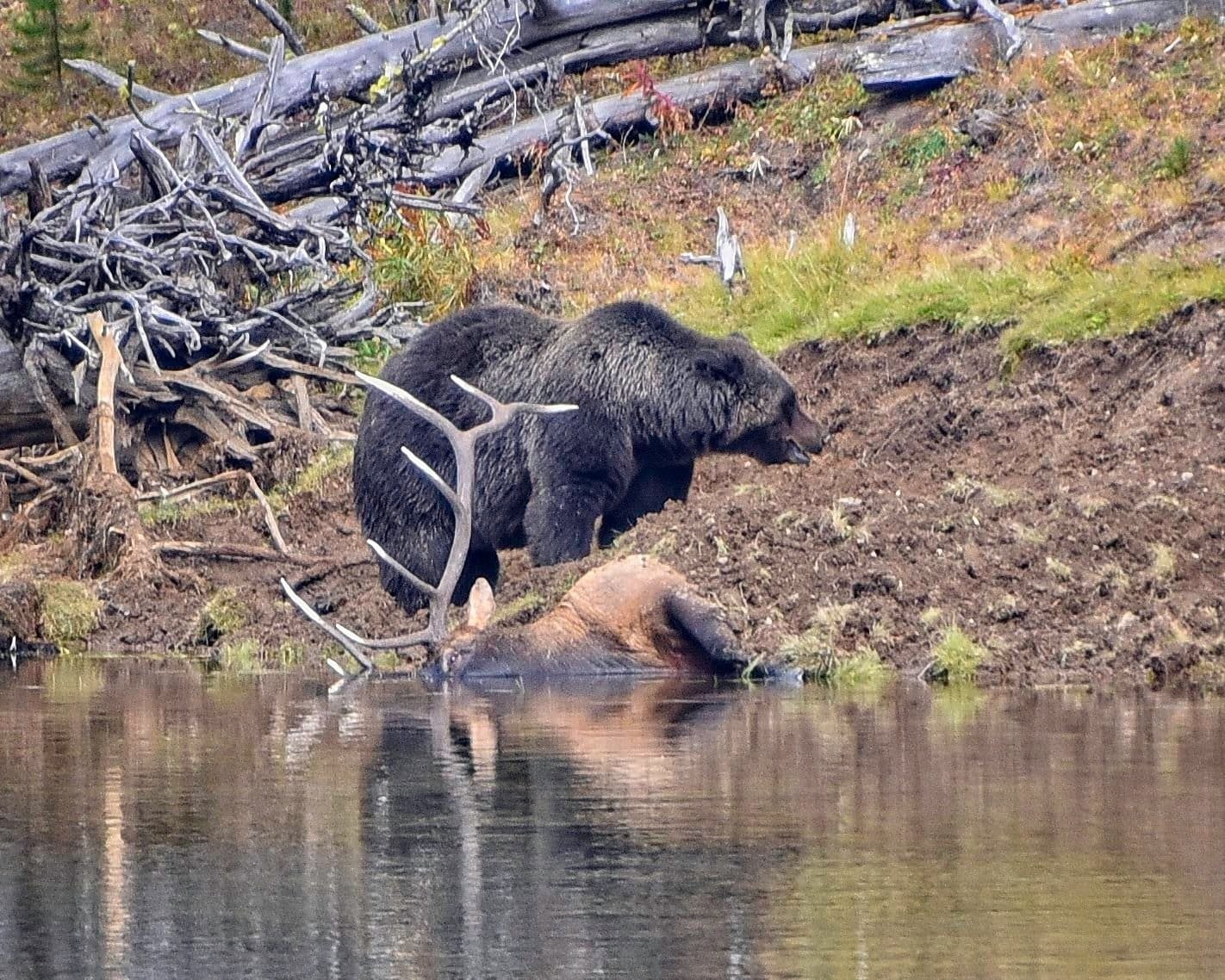
A gray wolf, maybe a mile and a half out, walking a game trail with that unhurried lope they have — and behind her, three more, one rolling in the snow like a dog. My hands were cold. I didn’t notice. I watched for eleven minutes and I would have stayed all day.
I’ve been on the other side of that eyepiece, too: squinting at a smudge through borrowed glass, waiting for someone else’s turn to end, hearing “you just missed it” for the fourth time that morning.
The difference between those two mornings wasn’t my eyes. It was eleven hundred dollars of glass that belonged to somebody else.
That’s what this page is about — what it costs to own the moment instead of borrowing it, and whether this particular scope is the right way to spend it.
A researched buying guide for wildlife watchers. I have used spotting scopes in Yellowstone and watched grizzlies and wolves through scopes shared by other visitors — but I have not used or tested this Viper HD model. Everything below is based on Vortex’s published specifications and practical viewing considerations, and I’ll be explicit about which parts of that story I lived and which parts I only researched.
Affiliate disclosure: As an Amazon Associate, I earn from qualifying purchases. If you buy through a link on this page, I may earn a commission at no extra cost to you.
See the current price on the 20–60×85 →Authorized dealers only. Price and availability change — verify the seller before ordering.
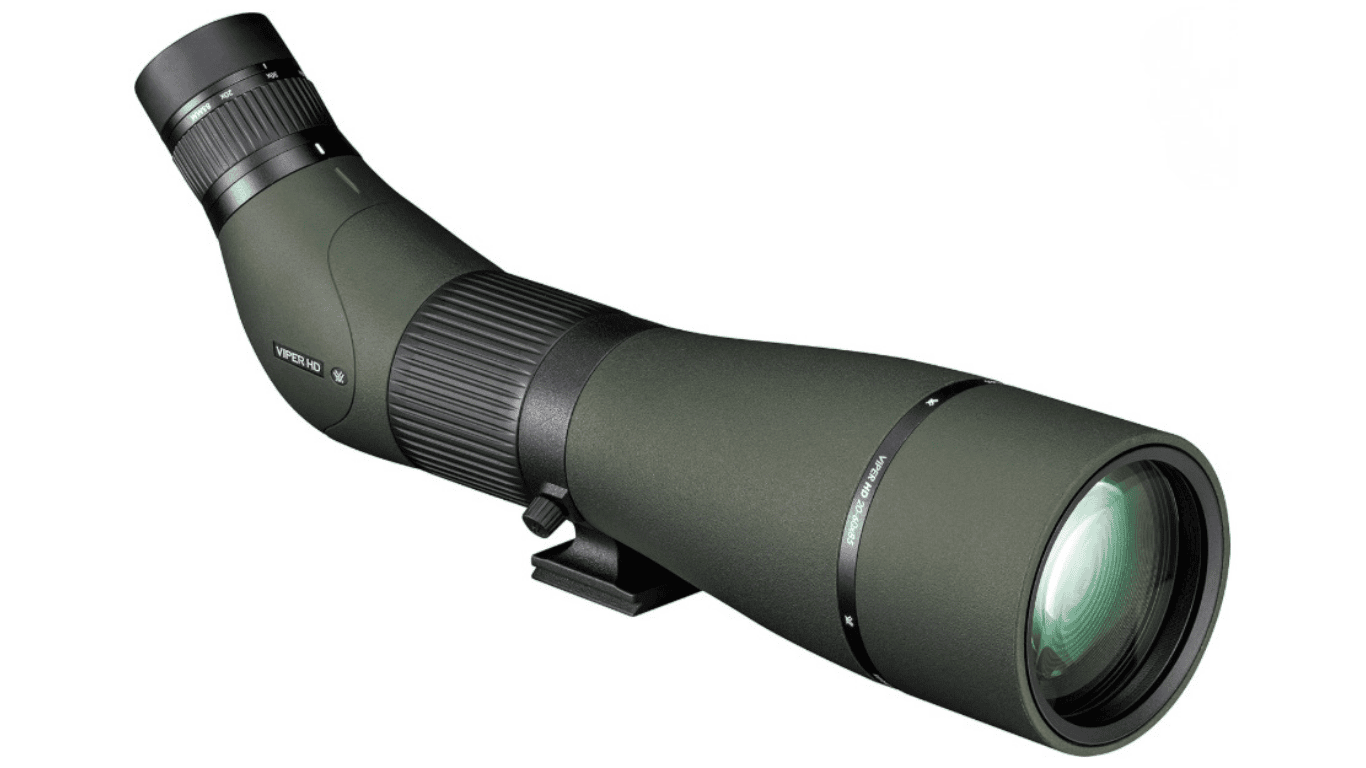
Angled Viper HD, view one
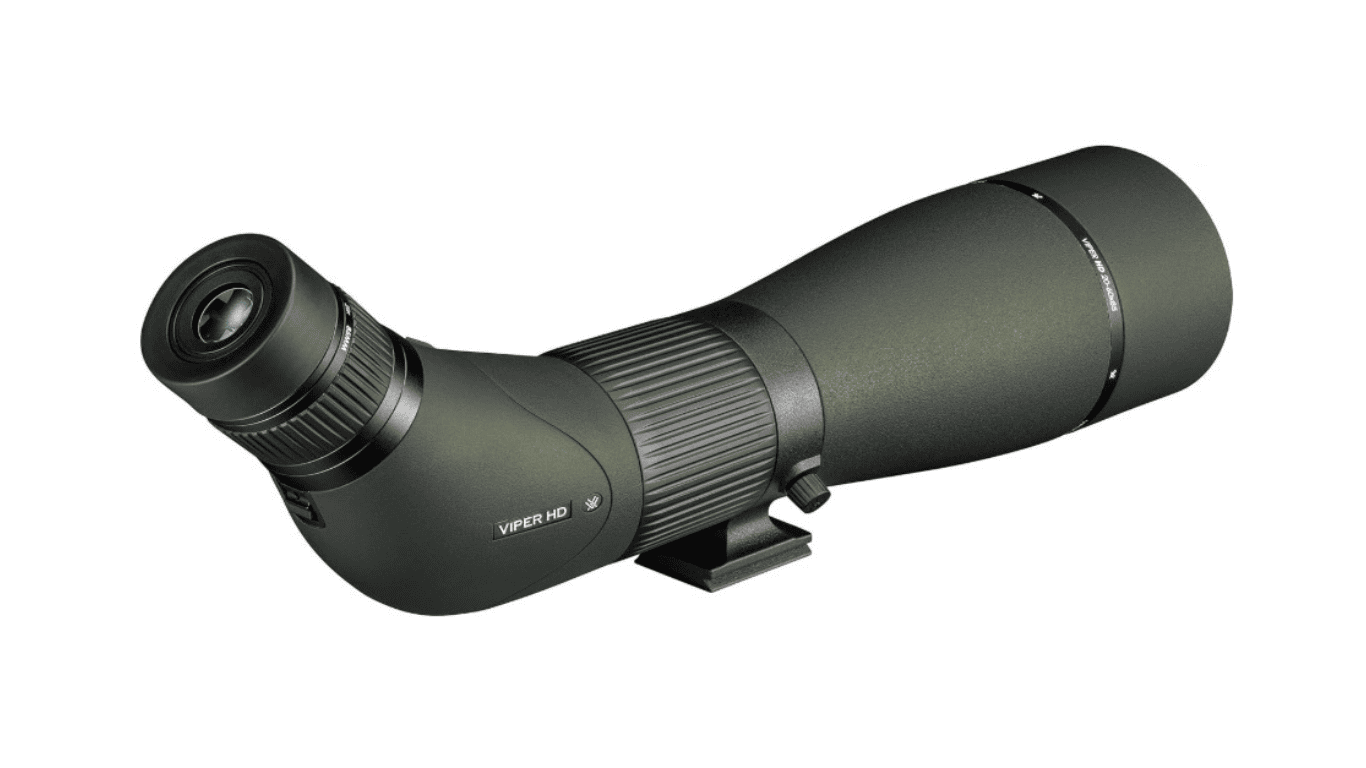
Angled Viper HD, view two
Quick verdict
The 85 mm Viper HD makes the most sense for wildlife watchers who settle at an overlook, use a sturdy tripod, and want a closer look at animals beyond comfortable binocular range. Its 20–60× zoom, larger objective and HD optical system offer a compelling specification set for that job. It is a substantial scope to carry, and 60× will not turn distant heat shimmer into detail.
A good fit
-
Stationary wildlife watching in open country
-
Birders and park visitors who share a scope with a group
-
Readers budgeting for a stable tripod as well as the scope
Think twice if
-
You hike far with everything on your back
-
You mostly watch nearby birds or handheld views
-
You expect a crystal-clear image at 60× in midday heat
Why a spotting scope changes a wildlife day
The speck problem
At a mile, a grizzly is a moving dot. Not a bear — a dot that appears to drift. Put a 400mm lens on it and you get a bigger dot, which is worse in a way, because now you can prove to yourself that something is out there and still not see it. Wildlife watching lives or dies on that gap: the animal is present, the day is passing, and your gear is deciding whether any of it reaches you.
What shared glass actually gives you
The first scope I ever looked through at Yellowstone wasn’t mine. A stranger had it set on a tripod pointed at a hillside I’d already written off, and he waved me in without being asked. What I saw was a sow grizzly working a slope with two cubs, one of them sliding down a snowbank on its back, and then the whole thing shifting — three wolves appearing along the ridge line, the sow gathering her cubs, everyone on the pullout holding their breath at once.
I stayed in that spot for over an hour. So did twenty other people. Somebody spotted, somebody focused, somebody kept the tripod from vibrating in the wind, and everyone got a turn.
That’s the part nobody puts in a spec sheet. A scope doesn’t just magnify distance. It turns a random roadside stop into a small temporary community, and it makes you the person who has something worth sharing.
Why “good enough” glass costs you the moment
Here’s the part that took me years to appreciate: a soft view doesn’t just look worse. It makes you work.
When the image is dull or fringed, your eye hunts. You bob your head. You roll the focus wheel back and forth chasing crispness that isn’t there, and the animal — the actual animal, doing the actual thing you drove six hours to see — keeps moving while you fiddle. Two minutes of that and the moment has moved on. Clarity isn’t aesthetics. Clarity is time, and time in the field is the only thing you can’t get back.
That’s my bias, and I’ll name it plainly. I care about image quality because I’ve had encounters I couldn’t quite see.
What this experience does and doesn’t prove
It shapes what I look for: edge-to-edge sharpness, a focus mechanism smooth enough to use with cold hands, a zoom range that stays usable at its far end, and glass that holds up in flat, harsh, low winter light. Those are the questions worth asking.
What it doesn’t do is tell you how this Viper HD performs. I have not used or tested this model. Everything that follows separates two things: what Vortex publishes about the scope, and what you should verify for yourself before you spend the money — ideally by finding one, or a comparable scope, and looking through it at something far away.
At Yellowstone, a distant animal can be a moving speck even through a long camera lens. Looking through a shared scope has let me watch grizzlies and wolves move and interact far away. Part of the joy is the little community that forms around the view: someone spots an animal, another person adjusts the scope, and everyone gets a turn. Those memories are why image quality matters to me. When the view is soft, a rare encounter can feel frustratingly out of reach.
That experience explains what I value in a scope; it does not establish how this particular Viper performs in the field. For this review, I separate published features from what a buyer should check personally.
What the specifications mean in the field
20–60× zoom and 85 mm objective
Start near 20× to find an animal, then increase magnification only as conditions allow. Vortex lists a field of view of 101 to 50 feet at 1,000 yards. At 60× you see a narrower patch of landscape, so finding a moving wolf is harder and tripod vibration becomes more obvious. The 85 mm objective helps gather light, but atmosphere, distance and support still limit visible detail.
A serious carry load
Vortex lists the straight V503 at 76.4 ounces and the angled V502 at 76.6 ounces—about 4.8 pounds before the tripod and head. That makes this an overlook or roadside scope for many wildlife trips, rather than an easy addition to a light hiking kit. Check your tripod’s actual stability and head compatibility before buying.
Focus, weather protection and mounting
Both variants list a 36-foot close-focus distance and 17.8–19.6 mm eye relief. Vortex describes HD glass, XR Plus anti-reflective coatings, a helical focus ring, argon purging and an Arca-Swiss-compatible mounting foot. These are manufacturer specifications, not measurements I made. A compatible head can accept the foot directly; another tripod may need a suitable plate or adapter.
Straight or angled?
The body style changes how people stand at the eyepiece. A straight scope can feel intuitive when following an animal along the horizon and is often convenient from a seated position or window mount. An angled eyepiece can be easier for people of different heights to share without repeatedly raising a tripod. Choose the viewing posture first; the published magnification, objective size, field of view and close focus match across V502 and V503.
Both supplied photos show an angled eyepiece from different sides. Vortex labels its angled 20–60×85 model V502 and its straight model V503. The supplied Amazon shopping link may offer multiple configurations, so confirm the selected model before checkout.
Compare the angled V502 specifications at Vortex Compare the straight V503 specifications at VortexBenefits and limitations
What stands out
-
An 85 mm objective suited to longer viewing sessions from stable positions
-
A zoom range that starts wide enough to locate an animal and reaches 60× when conditions cooperate
-
A mounting foot designed for Arca-Swiss compatible heads
-
Vortex’s published VIP warranty for damage or defects, subject to its stated exclusions
Trade-offs to plan for
-
Nearly five pounds before tripod, head or bag
-
A narrower field at higher magnification
-
Heat shimmer and wind can erase the benefit of extra zoom
-
A tripod and head add to total cost; the linked listing and selected body need checking
Price, warranty and buying checks
Vortex currently lists $1,349.99 as MSRP for both body styles. That is a manufacturer suggested retail price, not a live Amazon price; check the actual listing, seller, condition and returns before deciding. Also budget for a tripod and head capable of holding the scope steady at higher magnification. If you are still comparing models, see how to choose the best spotting scope for the money.
Vortex says its VIP warranty covers repair or replacement when a product is damaged or defective, but excludes loss, theft, deliberate damage and cosmetic damage that does not affect performance. The retailer’s return policy is separate. Review both before buying.
Read Vortex’s VIP warranty termsAs an Amazon Associate, I earn from qualifying purchases.

- The Viper HD 20-60×85 Angled spotter is packed with features for incredible glassing and high end optical performance. A…
- The HD optical system comprised of premium components generates vivid high-definition images. XR anti-reflective coating…
- The smooth helical focus helps dial in your image for ultra-sharp viewing and maintains a trim profile for ultimate pack…
Frequently asked questions
Is 60× always the best setting?
No. Starting lower makes it easier to locate and follow wildlife. Increase zoom when the air is steady and the tripod holds still; back off if the image looks dim or shimmery.
Can I use it without a tripod?
For sustained viewing at 20–60×, plan on a stable support. The scope’s weight and magnification make a suitable tripod and head a practical part of the kit.
Does the 85 mm version suit backpacking?
It can travel, but at roughly 4.8 pounds for the scope alone it asks a lot of a lightweight pack. A smaller 65 mm model may make more sense when walking distance matters more than stationary viewing.
Is the straight version better than the angled version?
Neither body is universally better. Straight can be intuitive at eye level; angled may be easier when several viewers of different heights take turns. Check the exact model selected in the retailer listing.
My recommendation
Buy the Viper HD 20–60×85 if your wildlife days look like this: you drive to a viewpoint, park, set up, and stay. Long hours at one spot, animals at distance, cold air, flat light, and somebody standing next to you asking for a turn at the eyepiece.
That’s the day this scope is built for, and on paper its strengths line up with it — the magnification to reach a wolf at a mile and a half, the 85mm objective to keep the view usable when the sun never really comes up. It’s the kind of glass that turns a pullout into a destination.
It is not the scope for the other day: the one where you walk in four miles and count ounces. Add the tripod, the head, and the case, and you’re carrying a system, not a scope. If you hike to your wildlife, weigh the whole rig — not the spec-sheet weight of the body — and compare it against something smaller before you commit.
See the current price on the 20–60×85 →Authorized dealers only. Price and availability change — verify the seller before ordering.
Keep exploring
New to spotting scope numbers? The guide below explains what magnification and objective size tell you before buying.
What 20–60×80 means before you buy a spotting scope