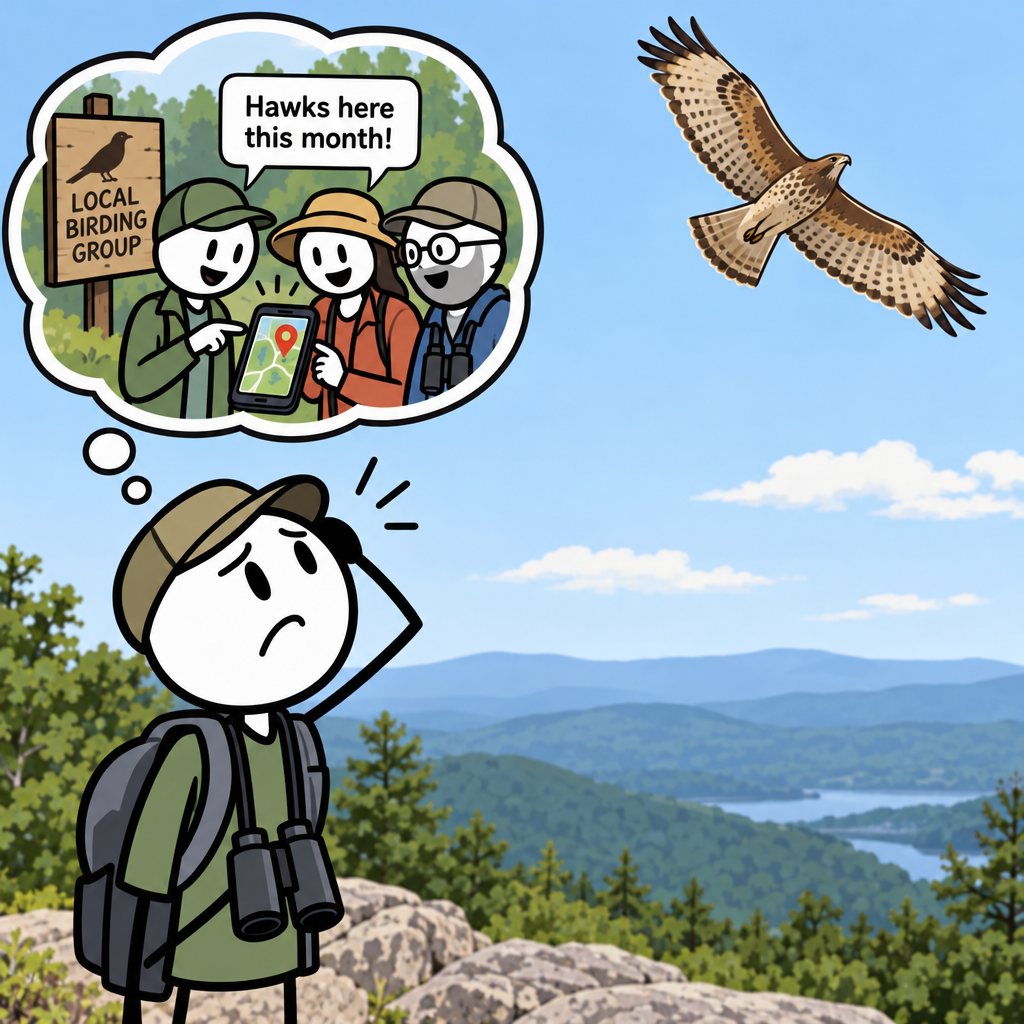
Someone once posted a short, slightly fed-up note to a birding group in Upstate South Carolina, and it said, “No raptors spotted at Caesars Head today.”
The locals answered quickly and kindly. Broad-winged Hawks had been passing all day, they said, and so had migrating Bald Eagles, but most of them were “way, way up” and hard to see without binoculars.
I think about that post a lot, because it is the exact feeling behind the search “i can never find hawks near me.” You walk the trail with your camera ready, and you come home with a card full of squirrels and leaf litter, so you start to believe the hawks just aren’t around.
The hawks are almost certainly there, and a small group of people in your area already knows where they hunt and which month to go. Better still, they publish that knowledge where anyone can read it.
Once you know where to look, you can do a season’s worth of scouting in one evening at your kitchen table. Before we get to that group, though, it helps to understand why the trail keeps letting you down.
Why the trail is the wrong place to look
Hiking trails are built for walkers. They follow shade and stay inside the trees, which means the sky you can see from them is often a thin strip between branches.
Hawks spend much of their time in places you can’t see from that strip. They ride warm air over open fields and along ridges, and they sit on edges where woodland meets grass so they can watch the ground for something to eat.
One experienced birder on BirdForum put it in a single line that I wish every trail photographer could read on day one.
“It is never easy or advisable to look for the raptors within the woodland, far better viewing over the tops of the trees.”
That explains a lot of days spent walking trails but not seeing birds of prey. You could add miles to your walk and it would barely help, because the extra miles are still under the canopy.
The Caesars Head story adds the second half of the problem. Even when you are in the right place, many raptors are high enough that they look like specks, so without binoculars you will scan the sky and honestly believe it is empty.
So the fix comes in two parts. You need a vantage point that looks up and out over open ground or treetops, and you need optics around your neck so you can find birds before you try to photograph them.
The good news is that you don’t have to discover those vantage points by trial and error, because someone near you has been doing it for decades.
Your local Audubon chapter and its field-trip calendar
That someone is your local Audubon chapter, or a bird club that does the same job under a different name. Their field-trip calendar is one of the best raptor maps you will ever read, and it usually sits on a plain website that hasn’t been redesigned since 2009.
Take the Appalachian Audubon Society in central Pennsylvania. Every fall it runs a trip to Second Mountain Hawk Watch, a ridge at Ft. Indiantown Gap that, in the chapter’s own words, “sometimes surpasses renowned Hawk Mountain on its daily fall migration counts.”
Hawk Mountain is famous, and photographers travel across states to stand on it. Meanwhile a quieter ridge nearby sometimes beats its numbers, and the chapter calendar gives you the date and the hours (10 am to 2 pm) and even tells you that a veteran hawk watcher will be leading.
It also tells you what to expect. Participants should see Bald Eagles and Ospreys, plus Broad-winged Hawks in good numbers, and that level of detail is something a general “hawks near me” search will never give you.
The same calendar lists something stranger. Each May to June, volunteers run a Falcon Watch in downtown Harrisburg, watching young Peregrine Falcons learn to fly from the Rachel Carson Building.
No trail walker would ever find that, because it is an office building in a city. And yet it is one of the most reliable places in the region to photograph a falcon in the weeks when the young birds are clumsy and easy to follow.
The chapter’s winter and early-spring trips keep the map going through the cold months. They point to Bald Eagles, and to possible Northern Harriers, at Middle Creek.
Washington Crossing Audubon, further east, does the same thing in its trip notes. It describes a winter reservoir trip as prime time for Bald Eagles and for owls, “which frequently roost or nest in the area.”
Owls are the bird many trail photographers want most and rarely find, so it is worth pausing on the fact that a club is telling you, in writing, the season and the site where they tend to roost.
If you have ever typed something like “bird photography spots near me visiting” into a search bar and got a list of the same three big parks, this is the source you were missing. You may now be wondering whether these trips are only for serious members with spotting scopes, so that is where we go next.
Yes, you can just show up
I held back from joining club outings for years because I assumed they were cliquey and full of experts who would sigh at my questions. I was wrong about that, and I wasted a lot of good autumns because of it.
Hartford Audubon says most of its field trips are free, open to the public and welcoming to beginners. Kalamazoo Audubon lends binoculars to people on its trips, which solves the optics problem before you have even bought a pair.
Audubon magazine notes that most chapters run regular outings led by local experts. Washington Crossing Audubon says its hawk lookout “normally” has experienced hawk watchers there who help visitors identify the birds going over.
I would value that last point above the others, because on a hawk watch the regulars call out birds as they appear (“Red-tail over the second pine”), and that running commentary trains your eye faster than any app.
As a photographer, a little courtesy goes a long way on these trips. Tell the leader you are there with a camera and keep to the group’s pace, then save your questions for the quiet moments when the sky is slow.
You will probably leave with a phone full of notes about which field the harriers hunt over and which tree the eagles use, because birders love to share that with someone who is genuinely curious.
There is one gap, though. A club meets on a schedule, and as the writer of a Cornell Lab guide to trip planning pointed out, local clubs are “a great source of info” but they don’t offer 24-hour advice, so for what happened last week you need eBird.
The one-evening eBird routine, done right
You may already have eBird on your phone and use it as a feed of what people saw today. It works far better as a planning tool, and the routine below takes about an hour once you know it.
Step one: check your county’s Community Targets
Open eBird’s Explore page and look up your county. The county is the smallest area eBird sums up for you, and hotspots fill in the finer detail inside it.
On that county page, find the list called Community Targets. These are species that haven’t been reported yet this month but have turned up around today’s date in earlier years.
To make the list, a species has to have been reported in more than one year, including at least once in the past two years, so the list leans toward birds that genuinely come back.
Scan it for hawks, falcons, eagles and owls, and you will know which raptors should be in your county right now.
Step two: filter the hotspot map by month
Next, open Hotspot Explorer. By default it colours spots by all-time species totals, and the reddest ones grab your eye.
Change the date filter to the current month, or to the past week. In the Cornell Lab walkthrough I mentioned, the writer did this for November and watched the red “hottest” spots disappear, because places that shine in spring can be quiet in late autumn.
Step three: read the bar charts and recent visits
Click into each promising hotspot and open its bar charts, which show how often each species is reported week by week. Press Ctrl+F and type the name of your target raptor so you can see straight away whether it turns up in your month.
Then look at the recent visits, because a Cooper’s Hawk logged three days ago is worth far more than one from five years back.
Step four: look for the frequency multiplier
Some hotspot pages flag “iconic” species with a short note showing how much more often they are seen there than in the wider region. The Raptor Trust hotspot in Morris County, New Jersey, for example, shows a species as “8.3x more frequent than regional average,” observed in 4 of 6 years.
Keep that number in your head for the next section, because it matters more than any total on the page.
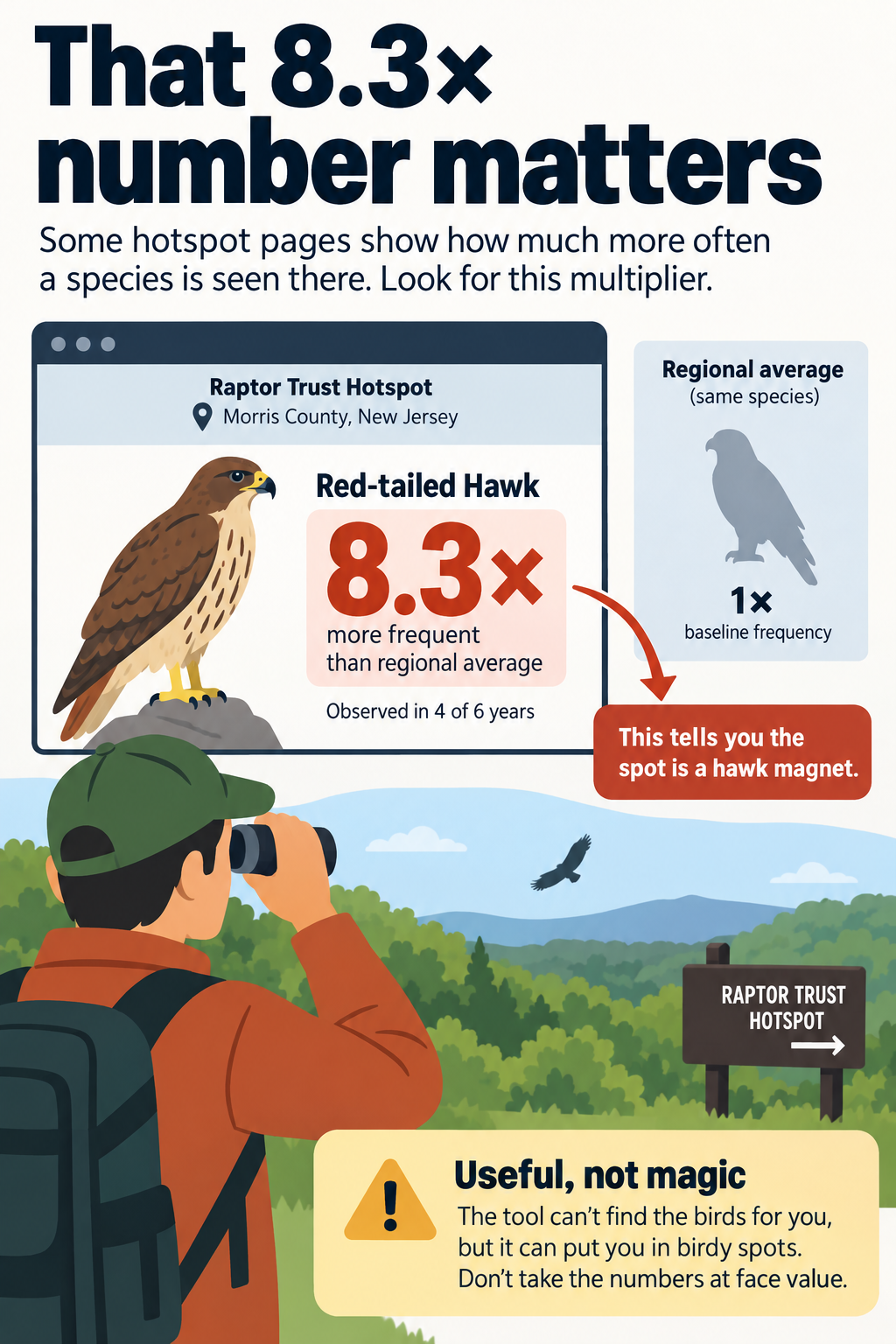
I should be honest with you about expectations here. The Cornell writer followed this whole routine and still missed most of his specific targets that day, and he summed it up well when he said the tool “can’t find the birds for you, but it can put you in birdy spots.”
Even “birdy spots” needs a warning label, though, because eBird’s numbers can mislead you badly if you take them at face value.
Where hotspot data lies to you
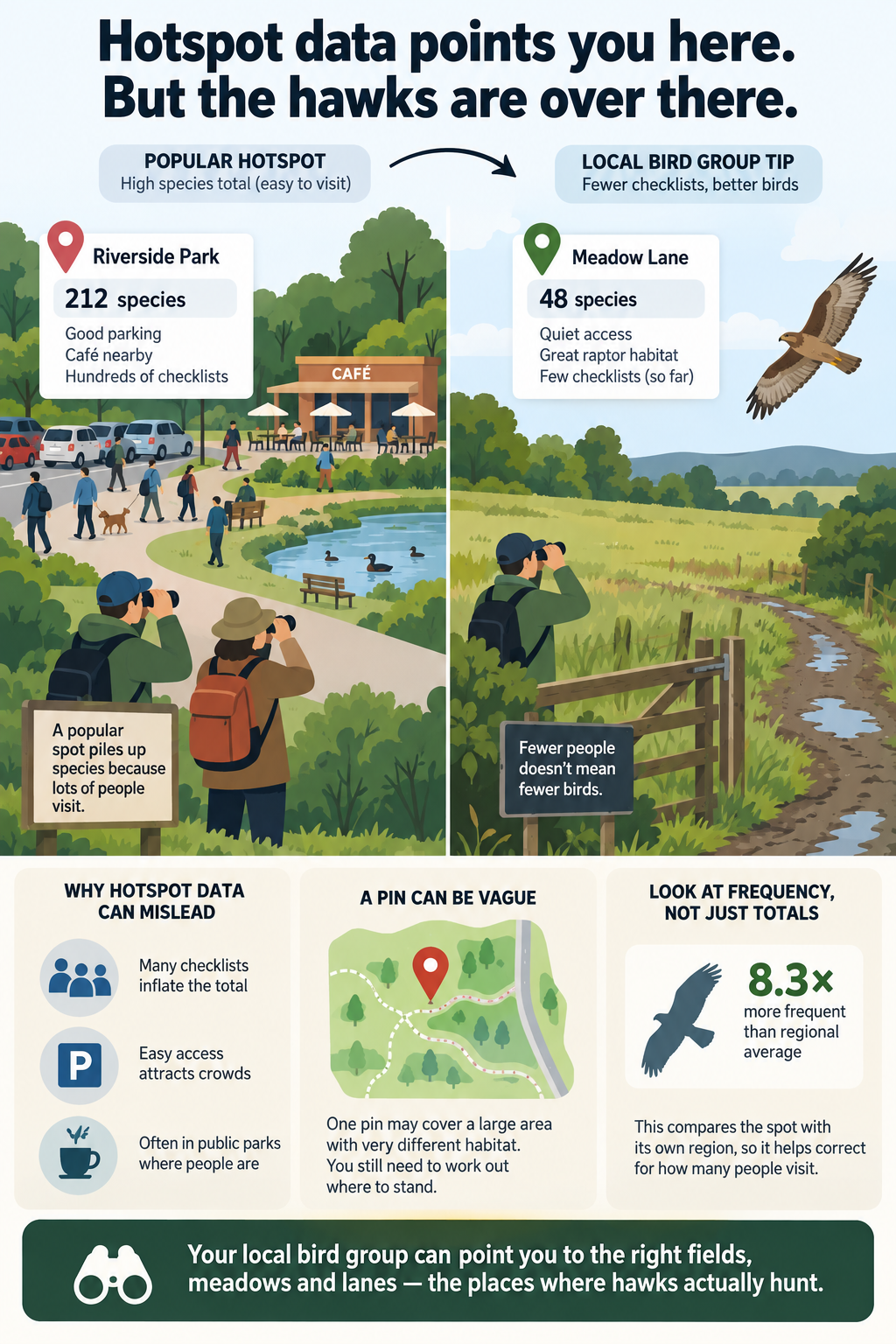
A thread on the birding forum of Reddit made an argument I have come to agree with. High species totals at a hotspot often reflect how easy the place is to visit, with good parking and a diner nearby.
Think about how the totals get built. Every checklist adds to the count, so a park that hundreds of people visit each week will pile up species even if its habitat is ordinary, while a better field down a muddy lane may barely register.
For a raptor photographer, that bias is a real trap. Sort by most species and you may end up at the busiest dog-walking park in the county, while the harriers hunt over an empty meadow a few miles away.
A bird photographer in another Reddit group went further and called hotspots “overrated.” They sit in public parks because that is where people are, he argued, while “birds are everywhere.”
I think he is half right, because hotspot data on its own will send you to crowds, and you still need to understand habitat, which brings us back to the vantage point idea from earlier.
The second problem is that a pin can be vague. Birders on BirdForum complain that some hotspots are “vague and unhelpful” when one pin covers a large property with many paths, or a long road running through very different habitat.
So a pin tells you which property to visit, and you still need to work out where to stand. A few things help with that.
The first is the frequency multiplier, which is why I asked you to remember it. A figure like “8.3x more frequent than regional average” compares the spot with its own region, so it partly corrects for the busy-park effect.
Even so, check how many years and checklists sit behind it, since a high multiplier from a handful of visits means little.
The second is the checklists themselves. Open a few recent ones and read the comments, because birders often write things like “harrier hunting the north field” or “kestrel on the wires by the lot.”
The third is the club. The trip notes we looked at earlier name the reservoir, the ridge or the building, which is the precise detail a vague pin leaves out.
There is one more source that cuts through all of this guesswork, because the people there count every raptor that passes.
Hawkwatches and the right time of year
If you keep thinking “i can never find wild raptors,” a staffed hawkwatch is the fastest cure I know. These are fixed lookouts, often on ridges or coastlines, where volunteers count raptors through the migration season.
HawkWatch International points beginners to HawkCount.org, which maps existing hawkwatch sites and shows their counts. Bird Collective says every state has a good hawkwatch somewhere, so there is very likely one within driving distance of you.
The numbers on a good day are hard to believe until you see them. At Rockfish Gap in Virginia, one watcher “clicked in” 6,865 raptors in a single day, and 6,825 of them came through in one surge.
Counted totals are the most direct evidence you can get of where raptors actually pass. The sites are staffed and open to the public, which makes a visit the exact opposite of wandering a trail and hoping.
Timing matters as much as place. Fall migration gets the attention, and that is when sites like Second Mountain do their big counts. If your outing takes you onto land open to hunting, plan for photographing safely during hunting season.
Spring has its own season, too. A Philadelphia-area group notes that birds heading north in spring can still be watched, even at sites like Militia Hill that no longer run an organised spring count.
Late winter is a good time for local birds as well. Virginia’s wildlife department says late winter and early spring are excellent times to look for resident raptors, because nesting has already begun and the birds are tied to one area.
That gives you a rough calendar. Hawkwatches suit fall and spring passage and late winter suits nesting residents, while the Harrisburg Falcon Watch reminds you that early summer brings young birds learning to fly.
With that calendar in mind, you can turn everything above into a single evening of planning.
Your scouting evening checklist
Set aside an evening with a cup of tea and work through these in order. It should take about an hour, maybe two the first time.
- Find your nearest Audubon chapter or bird club and open its field-trip calendar. Note any trip that mentions hawks, eagles, falcons, harriers or owls, and write down the site and date, along with the leader’s name.
- Open your county page on eBird and read the Community Targets list for raptors due this month.
- Open Hotspot Explorer, filter to this month or the past week, and shortlist two or three spots.
- Check each spot’s bar charts with Ctrl+F for your target species and read the recent checklist comments.
- Look for a frequency multiplier with several years behind it.
- Look up HawkCount.org for a staffed watch near you if it is fall or spring.
- On a map, find where your chosen spot looks over open ground or treetops, because that is where you will stand.
Then pack binoculars along with the camera. Find the bird with your eyes and the binoculars first, and only then lift the lens, because a long lens has a narrow view and you will lose a distant hawk while you hunt for it. Review your outdoor photography gear before heading out. Prepare your bird in flight settings too, so you can follow a takeoff without stopping to change controls.
The best single move on that list is the first one. Sign up for the next club trip that mentions raptors, even if it is a month away, and spend that morning standing next to the person who has watched that ridge for twenty years.
You will come home with photos, I hope, and also with a clear idea of where to go next week on your own. That person on the Caesars Head forum was standing under a sky full of hawks, and the only thing missing was someone telling them to look up.