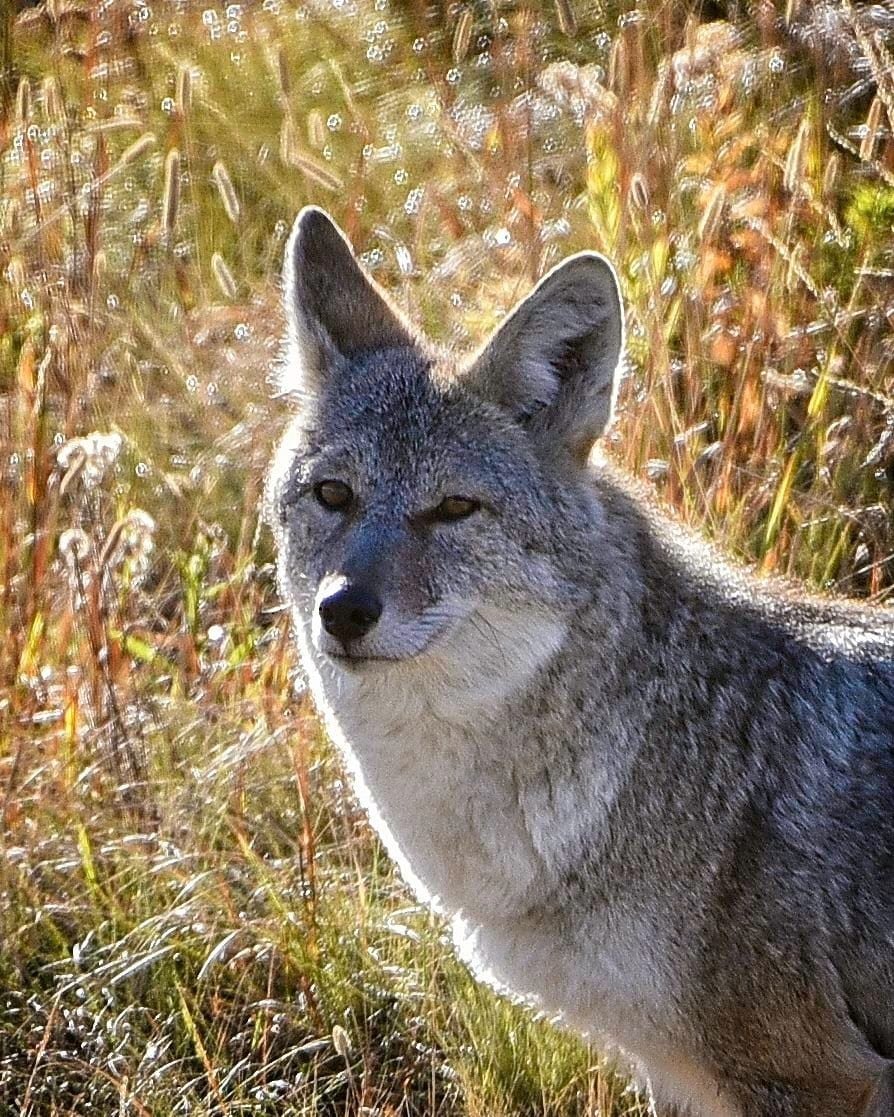
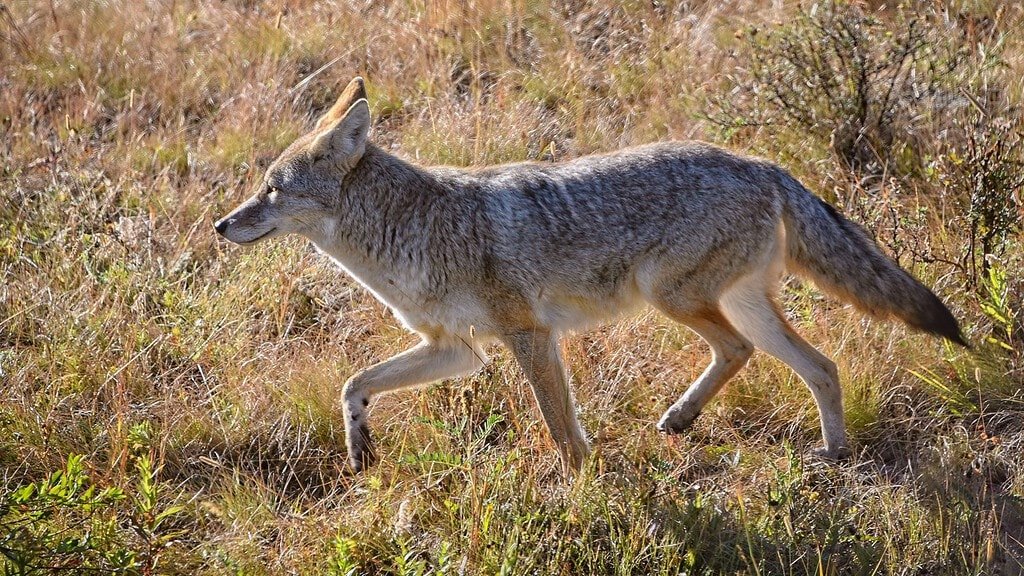
You have probably watched it happen. A coyote is trotting along the edge of a field in soft morning light, and it lets your car roll to a stop maybe forty metres away.
Then you open the door, and by the time your boots touch the gravel it is a grey shape heading for the tree line.
I have a folder full of the frames that come after that moment, and you likely have one too. Most of them show the back half of a coyote, slightly soft, with a smear of legs.
The good news is that the clean frame is usually decided before the coyote ever reacts to you. If you get a handful of things right inside the car, there is often one moment, a few seconds after the animal starts to move off, when it gives you exactly the picture you came for.
I’ll come back to that moment later, because it only pays off if everything before it is ready.
Getting a sharp coyote photo often comes down to preparing your camera before the animal notices you.
Why the coyote runs when you get out of the car
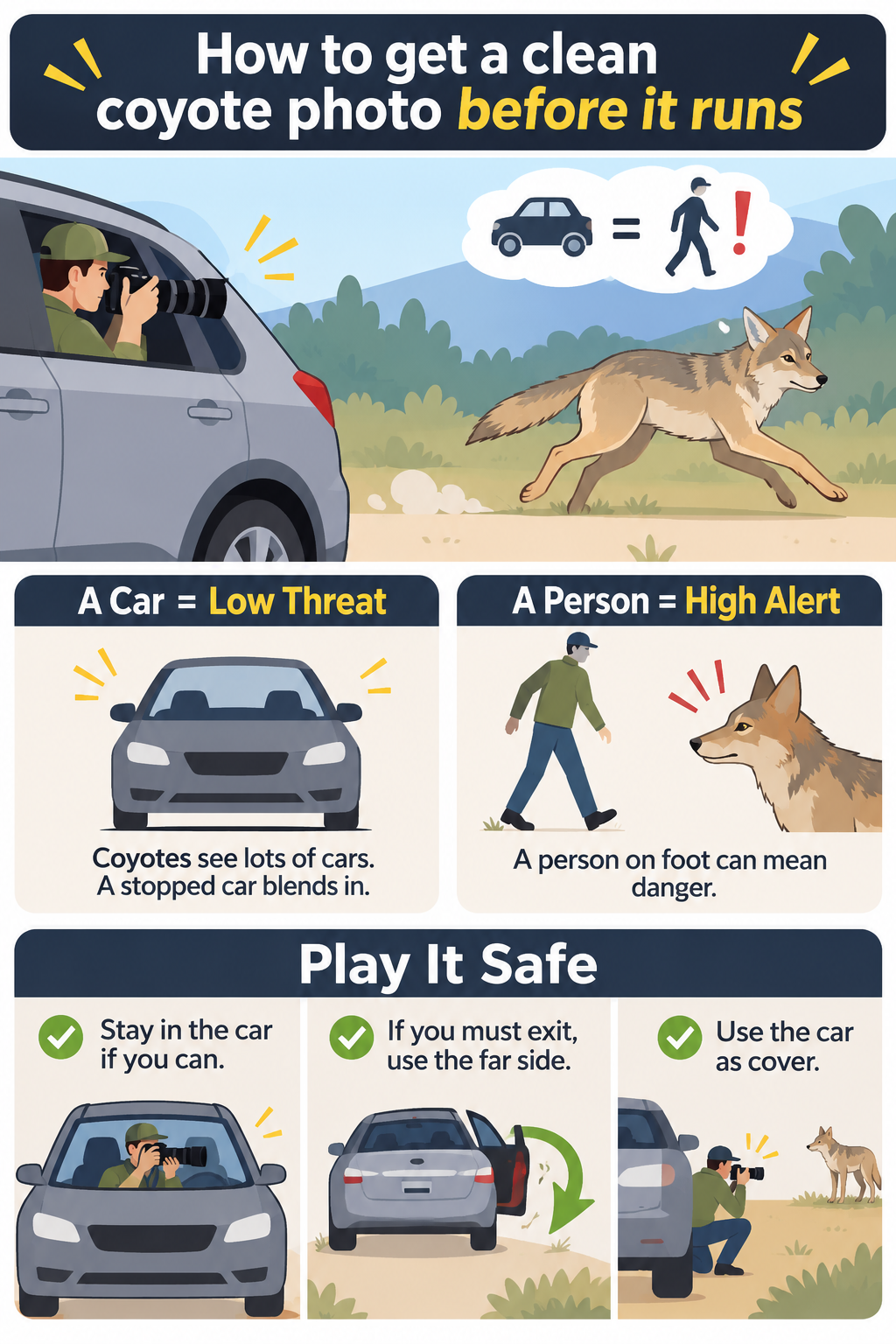
If your coyote runs when you get out of the car every single time, the reason starts with how that animal sees traffic. A coyote that lives near roads has seen thousands of cars that pass and park, and almost none of them have ever chased it, which means a stopped car becomes part of the scenery quite fast.
A person on foot means something else to that coyote. People on foot are the ones who have shouted at it or carried rifles, so the moment your shape splits away from the shape of the car, the animal is looking at a new and much more worrying thing.
Jim Roetzel, who photographs wildlife in Cuyahoga Valley National Park, reckons about 90 percent of his white-tailed deer work is done from his car. In his words, “a car does not threaten an animal nearly as much” as someone walking up to it.
Bird researchers have measured something close to this. A study in north-western Queensland looked at 13 wetland bird species and found that a person in a canoe could get closer before the birds flew off than a person walking (1).
Those are birds, so treat it as a hint about coyotes. That said, the logic carries over well, because in both cases a human inside a larger, familiar shape gets a calmer reaction than a human standing alone in the open.
Photographers who shoot from vehicles a lot put it plainly. If you are on the side of the car facing the animal, stay in your seat.
If you really have to get out, step out on the far side and shoot from around the car, using it as cover, and keep yourself from walking out into the open.
So the problem you have been trying to solve with stealth on foot is mostly solved by sitting still. The harder part is getting the car into place without spooking the coyote on the way in.
Arriving at a steady speed with no hard stop
When you spot a coyote from the road, your instinct is to brake, and that sudden stop is often what sends it off.
Diana Whiting, who photographs birds from her car, found that “a change of speed alerts a wary bird as much as stopping too quickly.”
Her habit is to hold normal road speed and drive past, then turn around and come back with the lens already resting on the window and the settings already dialled in.
Dan Carr did something similar with a hunting coyote in the Yukon. He slowed gently but kept rolling, because, as he put it, “a screeching halt right next to an animal” often scares it off or changes what it is doing. He carried on a few hundred metres and pulled off ahead of it.
A field experiment with vultures fits here too. Researchers drove a truck straight at turkey vultures feeding on bait and found the birds fled from 1.85 times farther away when the truck went 90 kph than when it went 30 kph (2).
At the top speed the birds’ reactions also became erratic, with some leaving at 40 metres and others at 220.
What I take from that is that a slow, steady approach gives an animal time to decide you are harmless, so you want to be the dull car that keeps rolling along at the same pace.
Where you look matters as much as how you arrive. Coyotes often travel along or beside roads in the early morning and the evening, so those are the hours to drive slowly with your eyes on the verges.
Two rules follow from all this, and the first is that you never chase a coyote with the car, because following it turns you from scenery into a pursuer.
The second rule is that once you have stopped, you stay stopped. Roetzel’s advice is to turn the engine off and stay put, since edging forward again can startle anything nearby.
Of course, dawn and dusk are exactly when the light is too low for an easy fast shutter, and that is where most blurry coyote photos begin.
Camera Settings for a Sharp Coyote Photo
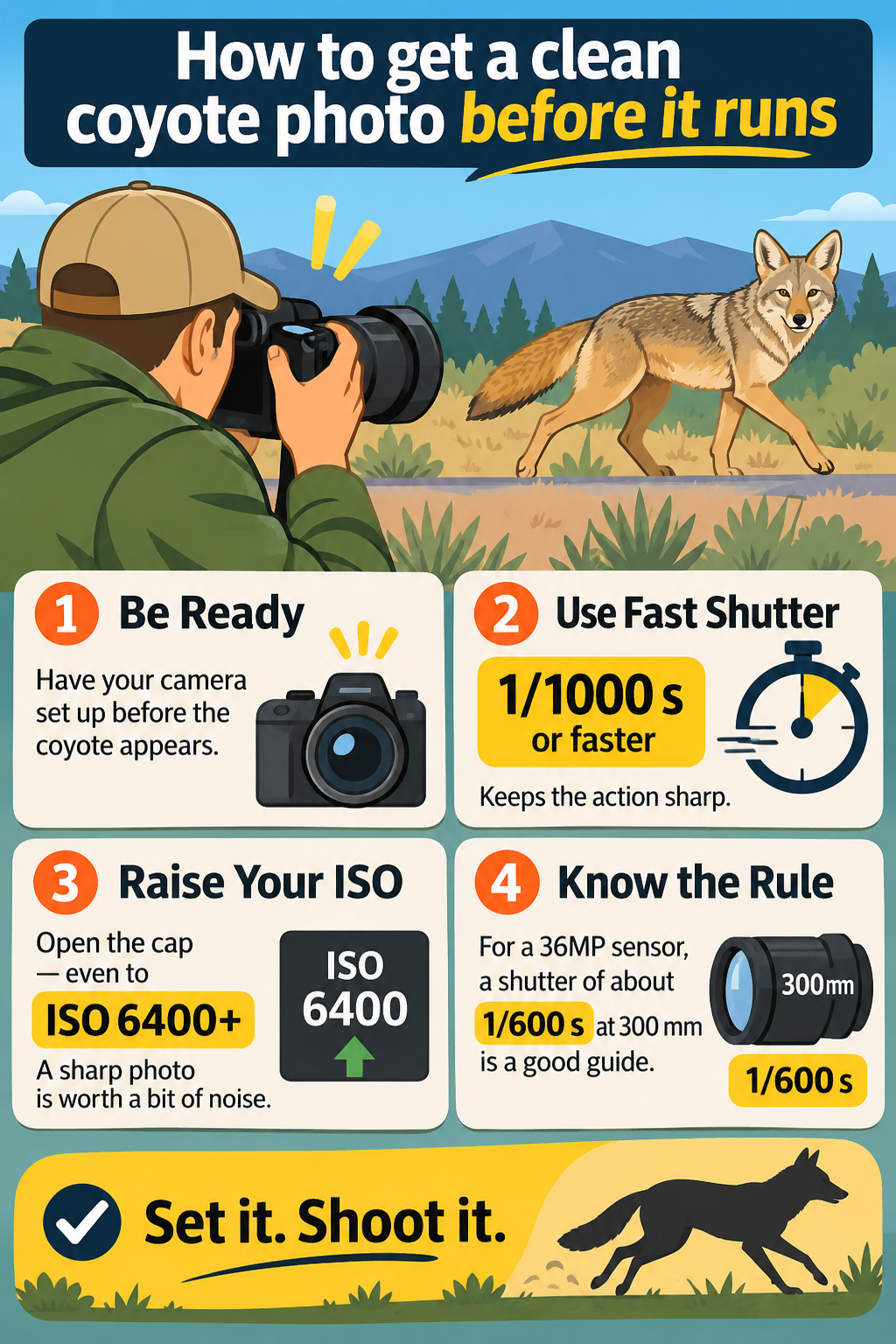
If you want to know how to get a good coyote photo before it runs, the answer is to have the camera ready to take it before the coyote is even in view. Once the animal appears you have seconds, and any of those seconds spent turning dials are gone.
The first number to settle is shutter speed. The National Park Service guide to shooting from your car suggests a minimum of 1/250 s at around f/5.6 for portraits, while Sudhir Shivaram, who shoots a lot of wildlife from vehicles, runs 1/1000 s or faster with continuous high-speed drive.
I side with the faster number for coyotes. 1/250 s works for an animal sitting still, but a coyote you meet on the road is almost always trotting or turning, and even its pause includes a head swinging round.
So set 1/1000 s as your floor and go faster if the light allows.
The setting that quietly ruins this is your Auto ISO limit. Plenty of cameras end up with a maximum ISO of something like 400, either from the factory or from an old shoot.
In bright light you never notice the cap, but at dawn the camera hits that ceiling and starts slowing the shutter to get a bright enough picture. So you think you are at 1/1000 s, and you are really at 1/160.
Open the cap up to whatever your camera handles, even 6400 or 12800. Modern noise reduction handles grain very well, so a sharp frame at ISO 6400 is something you can actually use.
High-resolution bodies leave even less room for shake. One rough guide for a 36-megapixel sensor is a shutter of about one over twice your focal length, which works out to around 1/600 s at 300 mm, and that is before the coyote moves at all.
Then you have to deal with your own body, because people who call coyotes in for photos say the animals can arrive fast, and the simple act of dropping the call and getting your face down behind the camera is enough to be seen.
Lifting a long lens off your lap when a coyote steps out is the same kind of movement. So rest the lens on the window sill or a window mount before you start driving the stretch, and keep your eye near the viewfinder whenever you slow down.
When the coyote shows up, the only thing that should move is your finger. Even with all of that right, plenty of people still end up with soft frames, and the reason often has little to do with shutter speed.
Why a coyote fleeting shot comes out blurry even at 1/1000
If your coyote fleeting shot is blurry even at a fast shutter, the first suspect is the air itself.
Steve Perry of Backcountry Gallery calls heat refraction “the number one cause for soft or blurry images with wildlife photography.” He says it is “exceedingly common” and “often misdiagnosed as a lens or focus problem.”
Heat shimmer happens when warm air rises off the ground and bends light unevenly between you and your subject. On a long lens, across a sunlit road or field, it turns fur into mush, and no amount of autofocus tuning will fix it.
Your car makes its own version of this. Warm air from the cabin spills out of the open window right across the front of the lens, so the light passes through a small wave of shimmer before it even reaches the glass.
In one photographer’s thread about out-of-focus coyote shots, the cause turned out to be exactly that, mixed with shooting through the window glass.
The fix was to stop the car, wind the window fully down and push the lens out past the sill so the front element sits beyond that layer of warm air.
Then there is movement you never notice. A car sits on springs, so when you shift your weight it rocks slightly, and at 500 mm that tiny rock shows up as blur, with a running engine adding a steady buzz on top.
Turn the engine off and keep still while you shoot. If you still see shimmer, go out earlier, because cool morning air before the ground warms up gives you the cleanest view.
Once the car and camera are quiet and ready, the last thing left is timing, and this is where the coyote does most of the work for you.
Getting the coyote to pause while photographing
This brings us back to the moment I promised at the start. In my experience, and in the experience of many people who shoot coyotes from roads, a coyote that moves off at a trot will often stop after a few strides and look back over its shoulder.
Nobody I know of has counted how often this happens, so take it as something to be ready for. It makes sense, though, because a coyote that has decided you are only mildly worrying wants to check on you before it commits to leaving.
Getting the coyote to pause while photographing is mostly about giving it no reason to keep going.
If the car stays still and nobody moves, the animal’s check comes back calm, and the glance can turn into a full stop where it stands side-on and stares.
Keep your burst ready and fire as soon as the head starts to turn, because the best frame is often the first one, with light catching the eye while the body is still in motion.
How you look at the animal matters too. A study of saffron finches found the birds fled from farther away when the approaching person stared straight at them, and also when more people approached at once (3).
These are small birds in a city, and yet the pattern matches what coyote shooters describe in the field.
So while you wait for the coyote to choose its line, keep your face behind the camera and avoid leaning out to watch it with your bare eyes.
Passengers should stay low and quiet too, since a car full of heads turning toward the window looks a lot like a group of people.
Jacques Fortier, who photographs coyotes at Point Reyes, starts every encounter with frames from the car. He watches which way the coyote is heading and then quietly moves the car to a spot near that line, taking care to keep off the path itself.
Sometimes, though, the only good angle is from outside the car, and that is where the risk climbs.
When getting out does work
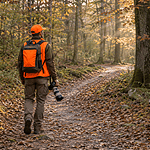
Getting out can work, and the two best coyote stories I know both involve a photographer on foot. If you are working on foot in an area open to hunting, review these precautions for sharing the woods with hunters before choosing your position.
Dan Carr’s Yukon coyote is the clearest example. After driving past and pulling off ahead of the animal, he walked into the grass and sat low, close to the coyote’s eye level.
Over about ten minutes the coyote hunted its way toward him and came, in his words, incredibly close.
If you look closely at what he did, though, he was settled and low in the grass well before the coyote arrived, and he was ahead of its route, so the animal came to him while he stayed put.
Fortier works the same way at Point Reyes. Only after shooting from the car and repositioning ahead of the coyote does he ease out, “low and slow”.
He has found that moving face-on toward a coyote usually spooks it, and he is blunt about the limit. If the coyote bolts at the sight of the car itself, “you don’t have any hope.”
So if you do get out, step out on the far side and stay low. Use the car or a bush as cover, and get into place well before the coyote reaches you, because walking out into the open toward the animal is the version that fills your card with tails.
Even when you get every step right, you should expect to come home empty-handed far more often than not, as the numbers from one very experienced photographer show.
Expect ten keepers from thirty trips
Fortier went to Point Reyes around 30 times in one year. He saw coyotes on nearly every trip, often several times in a day, and he reckons only about ten of those sightings gave him photos good enough for his portfolio.
That is someone who knows the place well and does everything described above, and most of his encounters still gave him nothing he wanted to keep. If your hit rate is lower, you are in good company.
The way to improve your odds is to go where coyotes are used to cars and are left alone, such as parks and quiet roads through open country.
Drive those roads slowly in the first and last hours of light, with the camera already set and resting on the window.
Then go back and do it again. Roetzel’s 90 percent figure is about deer, but the idea holds for coyotes too, because the car is where the reliable pictures come from, and every trip gives you one more chance at the few seconds when a coyote stops and looks straight back at you.
References
- Glover, H. K., et al. (2015). Avian flight distances from canoes versus walkers. Wetlands Ecology and Management, 23, 775. http://ui.adsabs.harvard.edu/abs/2015WetEM..23..775G/abstract
- DeVault, T. L., Blackwell, B. F., Seamans, T. W., Lima, S. L., & Fernández-Juricic, E. (2014). Effects of vehicle speed on flight initiation by turkey vultures: Implications for bird-vehicle collisions. PLoS ONE, 9(2), e87944. https://doi.org/10.1371/journal.pone.0087944
- de Resende, N. C., Teixeira, C. P., & de Azevedo, C. S. (2024). Flight initiation distance in an urban bird: Influence of the number of people, gaze orientation, and bird behavior. Birds, 5(2), 255-264. https://doi.org/10.3390/birds5020017